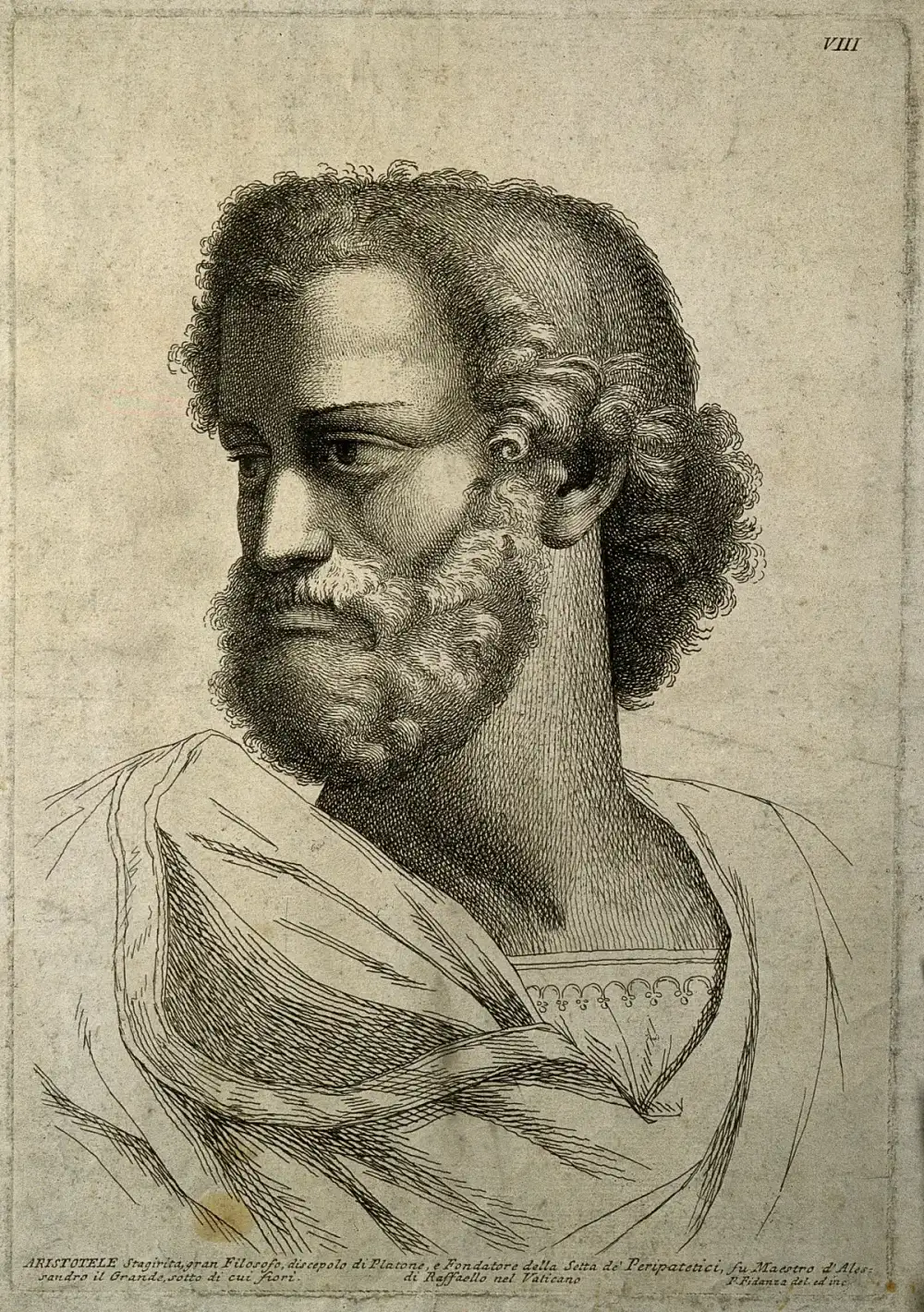
The Philosopher
384 — 322 BC
The man who systematized reality itself—cataloging the heavens and the earth, the soul and the state, the art of reasoning and the nature of being.
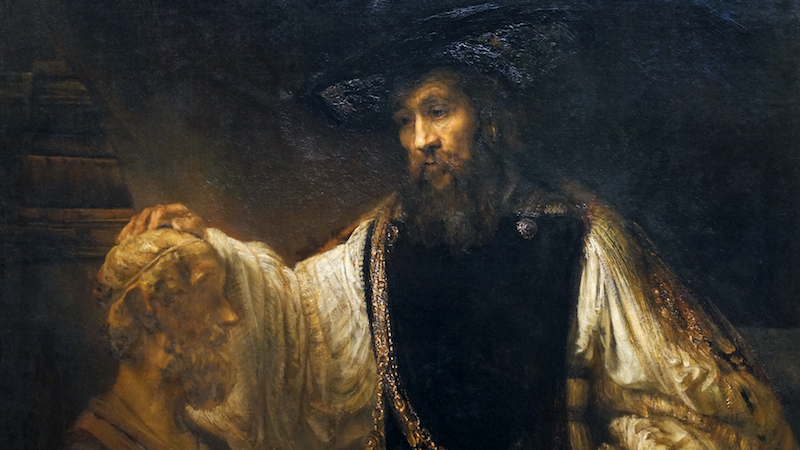
Rembrandt painted this masterpiece in 1653, showing Aristotle contemplating the blind poet whose works he analyzed in his Poetics. The philosopher's hand rests on Homer's head as if drawing wisdom across the centuries.
For two thousand years, to speak of "The Philosopher" was to speak of Aristotle alone. His works defined the curriculum of every medieval university. His logic governed all thought. His ethics shaped the moral imagination of the West.
Chapter I
Aristotle was born in 384 BC in Stagira, a small Greek colony on the northern Aegean coast, in the shadow of Mount Athos. His father, Nicomachus, was the personal physician to Amyntas III, king of Macedon and grandfather to Alexander the Great. This connection to the Macedonian court would shape the course of Aristotle's life.
From his father, young Aristotle learned the importance of careful observation. Medicine in ancient Greece meant studying nature directly—examining bodies, noting symptoms, tracking patterns. This empirical disposition, this trust in the evidence of the senses, would distinguish Aristotle from his future teacher Plato, who looked to the realm of abstract Forms.
Both parents died when Aristotle was young, and he was raised by a guardian. At seventeen, he traveled to Athens—the intellectual capital of the Greek world—and enrolled in Plato's Academy. He would remain there for twenty years.
Twenty years at Plato's Academy
"Plato is dear to me, but dearer still is truth."
— Aristotle, Nicomachean Ethics
Chapter II
The Academy was not a school in the modern sense. It was a community of philosophers gathered in a sacred grove outside Athens, dedicated to pursuing wisdom through dialogue and contemplation. Plato, then in his sixties, presided over discussions on mathematics, astronomy, music, and the nature of reality itself.
Aristotle proved himself the Academy's most brilliant student. Plato called him "the Mind" and "the Reader"—for his prodigious intellect and his unusual habit of collecting and studying books. But teacher and student differed in temperament. Where Plato was mystical and mathematical, drawn to eternal Forms beyond this world, Aristotle was practical and biological, fascinated by the living things of this world.
When Plato died in 347 BC, many expected Aristotle to lead the Academy. Instead, the position went to Plato's nephew Speusippus. Whether passed over or simply ready to move on, Aristotle left Athens. Some say it was also prudent: anti-Macedonian sentiment was rising, and Aristotle's ties to the northern kingdom made him suspect.
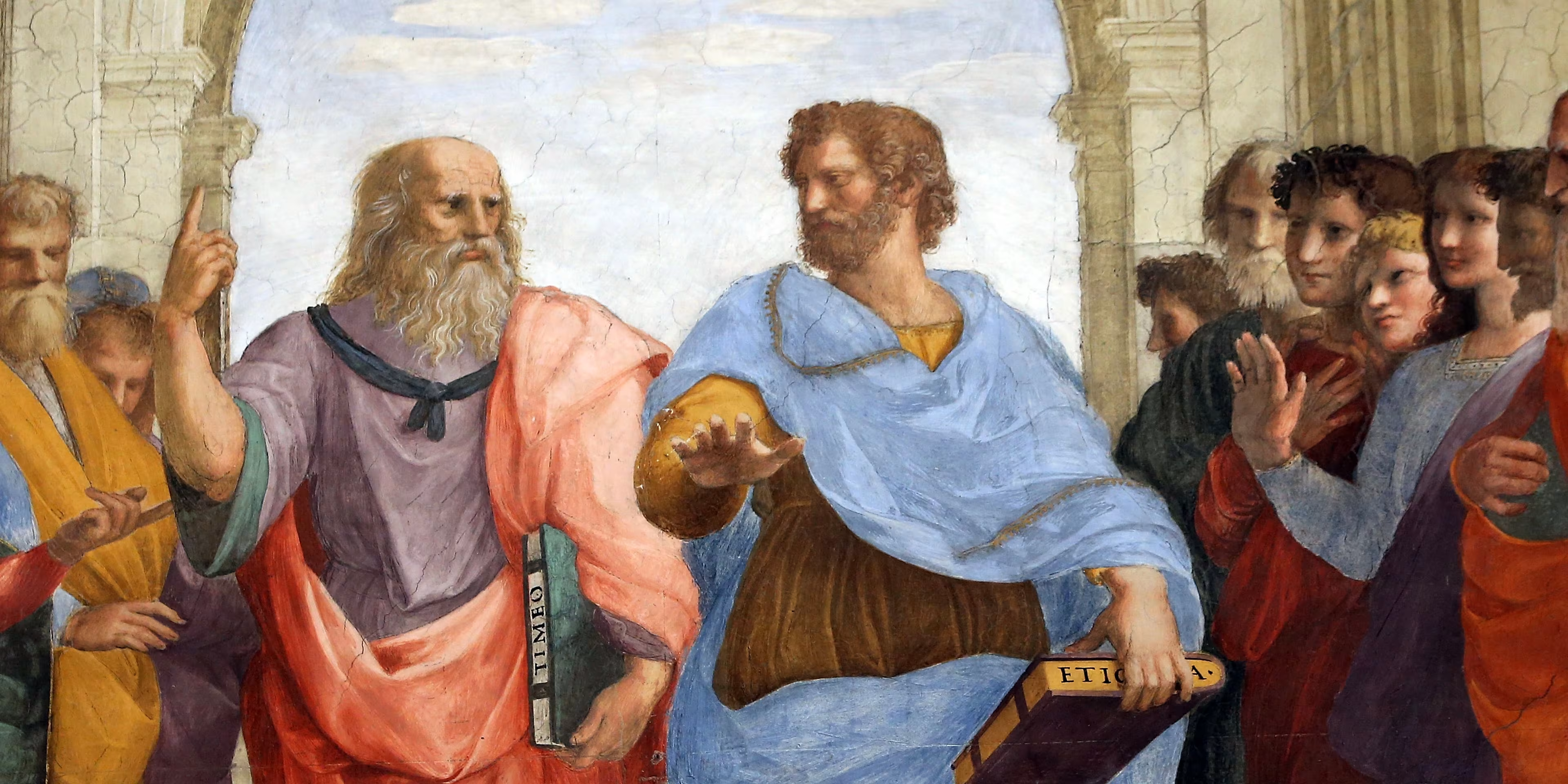
Raphael's vision: Plato points to the heavens, Aristotle to the earth
Chapter III
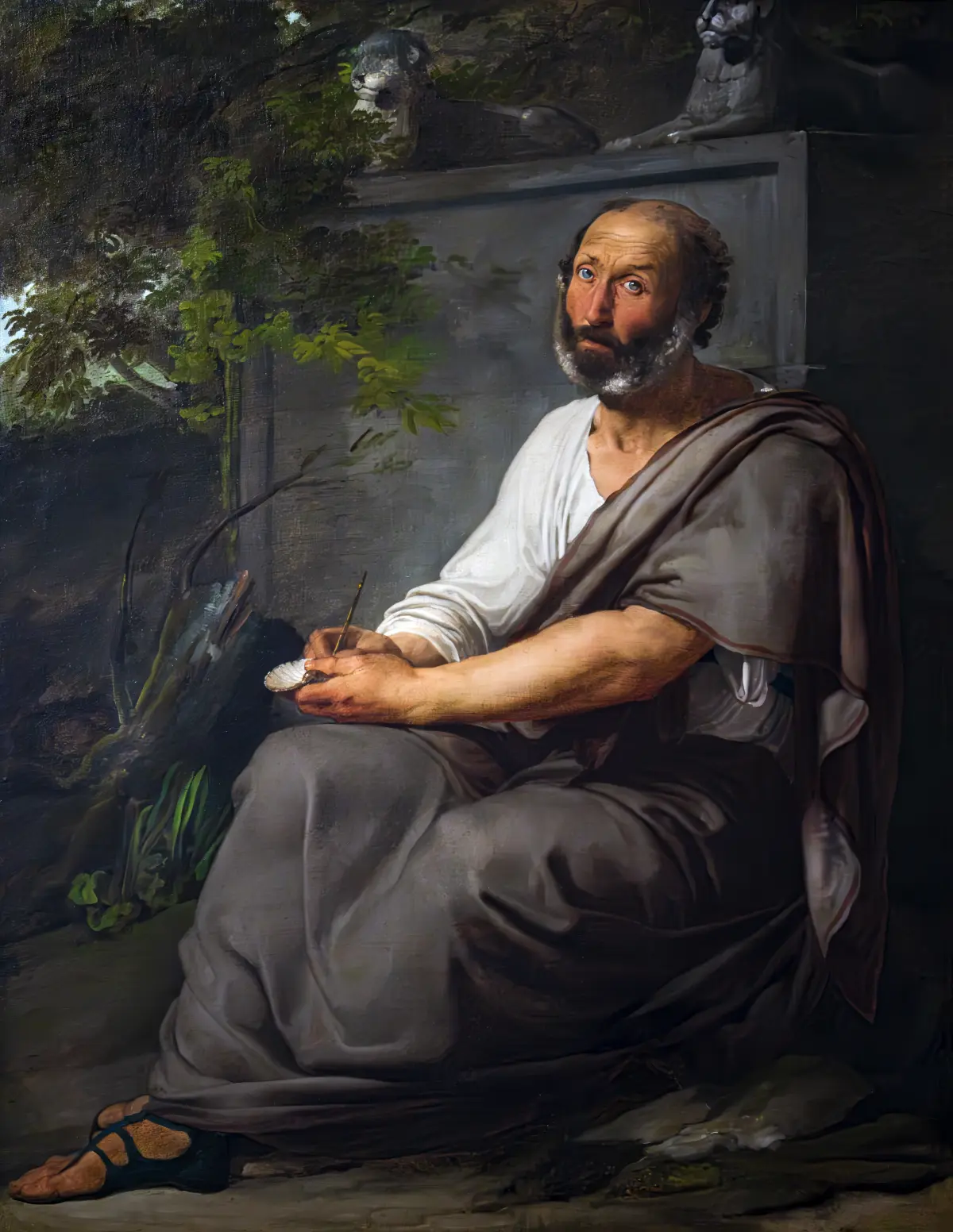
After leaving Athens, Aristotle traveled to the court of Hermias, a former slave who had become ruler of Atarneus in Asia Minor. There he married Hermias's adopted daughter Pythias and began intensive studies of marine biology along the coast. The observations he made there—of cuttlefish, sea urchins, and the reproduction of sharks—would form the basis of his biological works.
In 343 BC came a summons that would change history. King Philip II of Macedon invited Aristotle to tutor his thirteen-year-old son Alexander. For three years, the greatest mind of the age instructed the future conqueror of the world.
What did Aristotle teach Alexander? We know he edited a copy of Homer's Iliad that Alexander carried on his campaigns. He instilled in the prince a love of learning and Greek culture. Later, Alexander would send back botanical and zoological specimens from his conquests for Aristotle's research. But their relationship grew strained; Alexander's increasing autocracy and claims to divinity troubled the philosopher who taught that human flourishing requires the virtues of citizenship.
"We are what we repeatedly do. Excellence, then, is not an act, but a habit."
— Aristotle, Nicomachean Ethics
Chapter IV
In 335 BC, Aristotle returned to Athens and founded his own school in a gymnasium called the Lyceum, sacred to Apollo Lykeios. Because he taught while walking along its covered walkways—the peripatoi—his followers became known as the Peripatetics.
The Lyceum was a different kind of institution than the Academy. Where Plato emphasized mathematics and dialectic, Aristotle organized systematic research. He assembled a library, collected specimens, and directed collaborative projects. His students gathered constitutions from Greek city-states (158 in total), studied the histories of athletic games, and compiled records of dramatic performances. This was, in effect, the first research university.
During these twelve years in Athens, Aristotle produced his most important works: the Nicomachean Ethics, the Politics, the Physics, the Metaphysics, and treatises on logic, biology, psychology, and poetics. He wrote in two styles: polished dialogues for the public (now lost) and lecture notes for students (which survive). The difficulty of his surviving works reflects their origin as technical material for advanced study.
Organizing knowledge itself
Chapter V
What distinguished Aristotle from all who came before was his ambition to understand everything—and to do so systematically. He invented or formalized the very categories by which we organize knowledge: logic, physics, metaphysics, ethics, politics, rhetoric, poetics, biology, psychology.
His logical works, collected as the Organon ("Instrument"), provided the structure of valid reasoning that governed Western thought for two millennia. His syllogistic logic—"All men are mortal; Socrates is a man; therefore Socrates is mortal"—became the very model of rational argument.
In ethics, he rejected Plato's transcendent Form of the Good in favor of practical wisdom: virtue lies in the mean between extremes, and the good life is one of flourishing achieved through habituation and right action. In politics, he analyzed constitutions empirically, seeking not the perfect regime but the best achievable given human nature. In biology, he classified hundreds of species, dissected specimens, and made observations that would not be surpassed for two thousand years.
"It is the mark of an educated mind to be able to entertain a thought without accepting it."
— Attributed to Aristotle
Chapter VI
When Alexander died in 323 BC, anti-Macedonian feeling erupted in Athens. Aristotle, still connected to the Macedonian court, was charged with impiety—the same charge that had condemned Socrates. Rather than face trial, he fled to Chalcis on the island of Euboea, reportedly saying he would not allow Athens "to sin twice against philosophy."
He died there the following year at the age of sixty-two, probably from a stomach ailment. In his will, he provided for the emancipation of his slaves and asked that his wife's bones be buried with his own, as she had requested.
His school continued under Theophrastus, who expanded the biological and botanical research. But the works themselves traveled a strange path—hidden for centuries in a cellar in Asia Minor, damaged by damp and worms, then edited in Rome around 60 BC by Andronicus of Rhodes. It is this edition that shaped all subsequent philosophy.
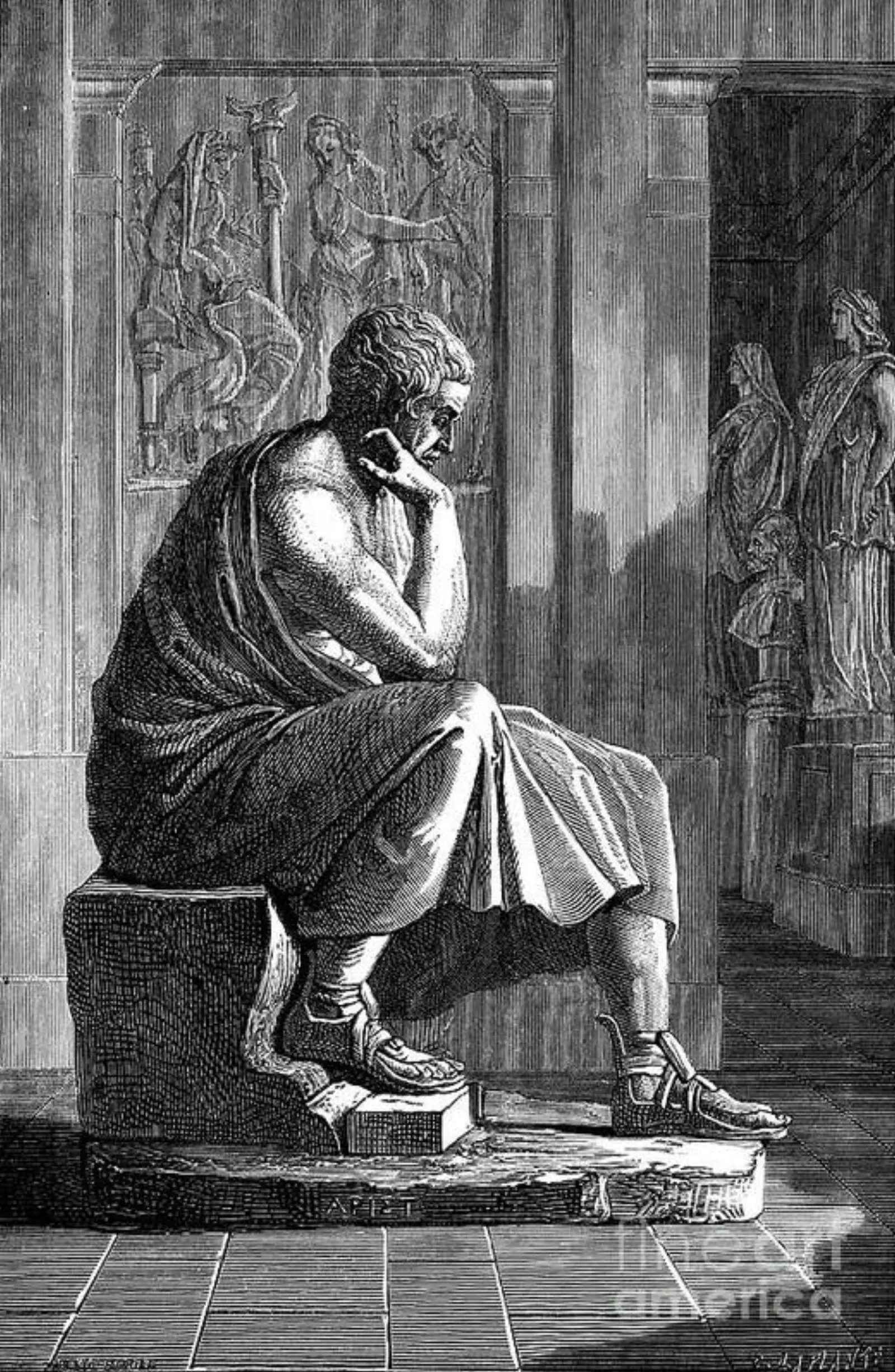
For two thousand years, there was no other name
The foundations of Western knowledge
Ethics
The most influential work of moral philosophy ever written. Named for his son Nicomachus, it explores the nature of happiness, virtue, and the good life.
Politics
A systematic study of constitutions and political organization, analyzing monarchy, aristocracy, and democracy in search of the best regime.
Logic
Six treatises on logic—the instrument of all reasoning. For centuries, to study logic meant to study Aristotle's syllogisms.
First Philosophy
"Being qua being"—the study of existence itself, substance and accident, potentiality and actuality, the Unmoved Mover.
Natural Science
The science of nature and change—motion, place, time, and the causes that explain why things are as they are.
Psychology
On the Soul—an investigation of life, perception, thought, and what distinguishes living from non-living things.
Rhetoric
The art of persuasion analyzed: ethos, pathos, logos—character, emotion, and argument as the means of moving an audience.
Literary Theory
The nature of tragedy, the role of catharsis, the elements of plot—the first systematic work of literary criticism.
For the Islamic Golden Age, Aristotle was simply "The First Teacher." For medieval Christendom, he was "The Philosopher"—no other name required. Thomas Aquinas synthesized Aristotelian thought with Christian theology, creating an intellectual framework that governed the West for centuries.
The scientific revolution defined itself against Aristotelian physics. But even in rejecting him, thinkers revealed his influence: you cannot escape a framework that shaped the very language of inquiry. His ethics remains central to contemporary moral philosophy. His logic provided the foundation for every subsequent advance. His method of systematic observation and classification established the template for scientific research.
To read Aristotle is to witness a mind grappling with the fundamental questions: What is real? What is good? How should we live? How should we think? Two and a half millennia later, we are still answering him.